Revenue Code Management, protect what you are owed in reimbursement
Protect Every Reimbursement Your Supplies Should Earn
Billable supplies with inaccurate revenue codes lose money silently, through underpaid claims, denials, and audit exposure finance teams discover quarters later. Genesis Revenue Code Management continuously monitors revenue code accuracy across file and non-file billable supplies and surfaces denial-risk patterns before they become rejected claims.

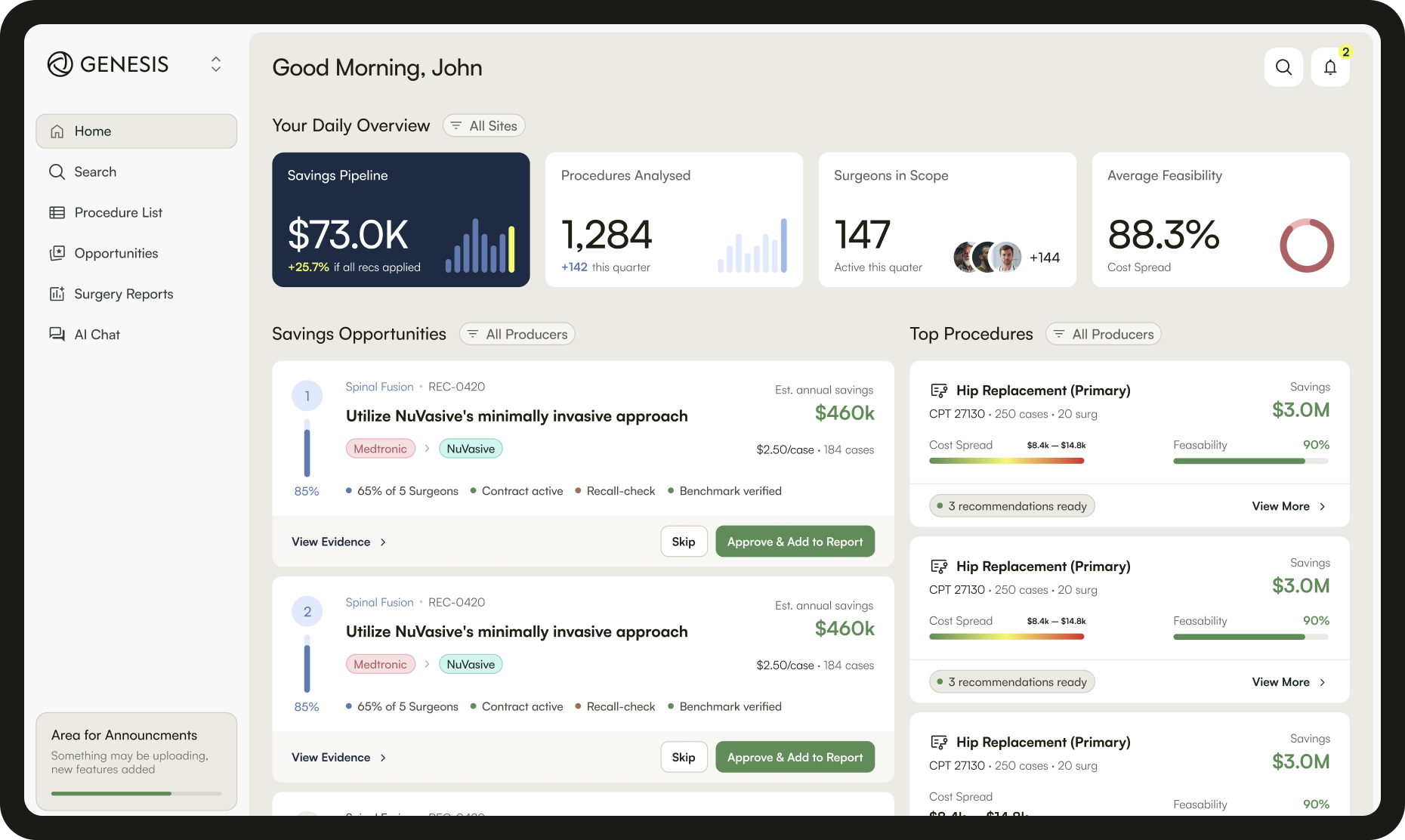
Drift Detected. Denials Prevented. Reimbursement Protected.
One screen shows active revenue code policies, drift alerts where coding has diverged from expected patterns, denial-risk flags, and the reimbursement-gap value quantified across the catalogue.
The Problem
Revenue code accuracy on supply items is a quiet leak in most health systems. Items get billed with the wrong code, a partial code, or no code at all, producing underpaid claims and denials that finance teams only discover in retrospective reviews, sometimes quarters later.
The Capability
Revenue Code Management runs continuous accuracy monitoring against the same item master and contract data already in Genesis. It validates codes at onboarding, monitors for drift as items get re-categorized, surfaces denial-risk patterns from community-validated payer behaviour, and quantifies
reimbursement gaps so finance teams can prioritise the biggest opportunities first.
The Outcome
Revenue cycle teams catch coding gaps before they hit a denial report, and finance teams get a quantified view of leakage instead of a retrospective surprise. Mary Rutan Hospital points to HCPCS Level II compliance for OPPS reimbursement as a critical piece of revenue cycle protection, the same continuous governance Revenue Code Management applies broadly.
Powered by Content Management
Built on the Same Governed Item Master Content Management Produces
Revenue Code Management runs on the same governed item master and coding engine as Content Management, with no separate data load and no parallel reconciliation. Revenue codes get applied at onboarding, and Revenue Code Management monitors them continuously, catching drift and quantifying reimbursement gaps over time.
What Content Management Provides
Continuously governed item data, contract pricing, recall intelligence, vendor catalogues, and industry codification.
Explore
What Revenue Code Management Delivers
Continuous accuracy monitoring, drift detection, denial-risk pattern surfacing, and quantified reimbursement-gap reporting.
Explore
"Clean data is the bedrock of a modern supply chain. By normalizing and attributing every item, we created the visibility needed to manage spend, reduce risk, and stay proactive, not reactive."
Common questions, answered directly
Frequently Asked Questions
Classification System applies the initial revenue code at onboarding alongside UNSPSC, GTIN, GUDID, and other billing classification codes. Revenue Code Management goes deeper on just revenue codes: continuous accuracy monitoring, drift detection, and quantified reimbursement-gap reporting. Classification System sets the baseline; Revenue Code Management protects it over time.
Every file and non-file billable supply item in the catalogue, including implantables, high-cost supplies subject to outpatient reimbursement rules, pharmaceuticals the supply chain handles, and blood products. Coverage is configurable per organisation.
Genesis monitors each item's assigned code against the expected pattern for its type, vendor, and clinical context, flagging changes without documented reason, divergence from equivalent items, or codes that no longer match current payer policy.
From two sources: community-validated patterns where customer claim outcomes show specific code-payer combinations triggering denials, and published payer policy guidance that conflicts with current assignments. Patterns are scored by frequency and value.
Revenue Code Management is payer-agnostic at the data layer, so the same revenue code data flows to whichever payer's or commissioner's claim it appears on. Denial-risk detection improves the longer a customer is on the platform.
When a national regulator or major payer updates revenue code policy, Genesis applies the update automatically and notifies revenue cycle teams. Policy clarifications surfaced at one organisation propagate to the rest of the Genesis customer community.
If Classification System is already running, Revenue Code Management typically activates in 30 to 60 days. For new implementations, it activates alongside Classification System as part of the standard rollout.
Every revenue code assignment carries documented evidence: the source authority, a full version history, and steward sign-off where applicable, so any item's coding history can be traced end to end.
Ready to Protect Every Reimbursement You Are Owed?
Talk to a Genesis expert about bringing continuous revenue code governance to your billable supplies.